Agent Quickstart#
Note
Requirements: same as the LIBERO Quickstart — a
GPU, the quickstart extra, and an LLM API key — plus
Claude Code (or another coding agent).
Budget about 10 minutes.
This walkthrough has Claude Code, armed with one skill, drive GaP end-to-end: it generates a pick-and-place graph from a single sentence, validates it, and the graph then runs in LIBERO sim. Every command and output below comes from a real recorded session — the generated graph put the cream cheese in the basket in 75 s, on video.
Two agent layers are involved — don’t conflate them:
Claude Code ──(the `gap` skill)──▶ drives the CLI: gap check / generate / run / skills …
                                         │
                                         ▼
                            gap's own codegen agent (`gap generate`)
                                         │  reads bundle SKILL.mds from disk
                                         ▼
                       skill registries (e.g. ../open-robot-skills)
Claude Code needs only the gap skill. The robot bundles in
open-robot-skills are consumed by GaP’s internal codegen
agent as files on disk — they do not need to be installed into Claude Code.
0. Prerequisites (once)#
git clone --recurse-submodules https://github.com/graph-robots/graph-as-policy.git
git clone https://github.com/graph-robots/open-robot-skills.git   # side-by-side
cd graph-as-policy
uv sync --extra quickstart            # engine + sim + perception bundles
uv run gap skills check --download    # validate every bundle
Model weights download from HuggingFace at the first model call;
--download additionally runs each bundle’s optional prefetch() hook
where a bundle defines one. See
Installation for details.
Pick an LLM provider for generation and for the VLM perception bundle
(gap check tells you what is configured):
export OPENROUTER_API_KEY=...         # simplest: one key drives both
# or vertex: gcloud auth application-default login, then
#   export GAP_VLM_PROVIDER=vertex GAP_VLM_PROJECT_ID=<proj> \
#          GAP_VLM_REGION=global GAP_VLM_MODEL=gemini-3.1-pro-preview
#   and pass a config YAML with the same llm: settings to gap generate
Provider details: LLM providers for generation, LIBERO Quickstart for the perception VLM.
1. Install the agent skill (once)#
claude plugin marketplace add graph-robots/graph-as-policy
claude plugin install gap@gap
Verify in a new Claude Code session: ask “What robot skills are
available?” — gap should be listed. The skill content lives at
agent/skills/gap in the engine repo; install
options for other agents (Cursor, Codex CLI, …) are in
agent/INSTALL.md. The full tour of what the
skill teaches the agent — including its safety gates and troubleshooting
playbook — is in Claude Code.
2. Ask Claude Code for a graph#
Prompt used in the recorded session:
Using your gap skill: generate a robot task graph for “pick up the cream cheese and put it in the basket” with output directory outputs/agent_gen_test. Then validate the generated graph without running any simulator or real robot.
What the agent does, all taught by the skill — you can run the same three commands by hand:
uv run gap check                                   # capability report first
uv run gap generate "pick up the cream cheese and put it in the basket" \
    --out outputs/agent_gen_test                   # add --config <yaml> for vertex
uv run gap run outputs/agent_gen_test/task_00 --validate-only
Expected ending: OK: 0 errors and a workflow directory:
outputs/agent_gen_test/task_00/
├── workflow.json      # 4 subgraphs: perceive_target, perceive_container,
│                      #   grasp_target (grasping-with-planner),
│                      #   place_target (transporting-objects)
├── scripts/           # the canonical skill scripts the graph calls
├── checkpoints/       # generated postcondition predicates
└── agent_traces/      # the codegen agents' own transcripts
Important
Generated output lands in <out>/task_00/ — point gap run at the task
subdirectory, not at --out itself.
In the recorded session the agent’s first gap generate hit a missing
vertex SDK — it read the error, ran uv sync --inexact --extra vertex, and
retried successfully. That self-repair is the skill’s troubleshooting
playbook working as intended.
How the generation pipeline itself works (coordinator, per-subgraph agents, validation loop) is covered in Generation.
3. Run it in sim (with video)#
The cream-cheese scene is task 1 of the libero_object_all_variance
suite (classic LIBERO numbering):
MUJOCO_GL=egl uv run gap run outputs/agent_gen_test/task_00 \
    --sim libero_object_all_variance/1 \
    --record-video --trace-dir outputs/agent_gen_sim
Recorded result:
SUCCESS (exit=success, 75.0s)
trace: outputs/agent_gen_sim
checkpoint: ... name='target_held'      passed=True   ← gripper held the cream cheese
checkpoint: ... name='target_in_basket' passed=True   ← it ended up in the basket
video: outputs/agent_gen_sim/run_video.mp4 (506 frames)
Frames from the recorded run:
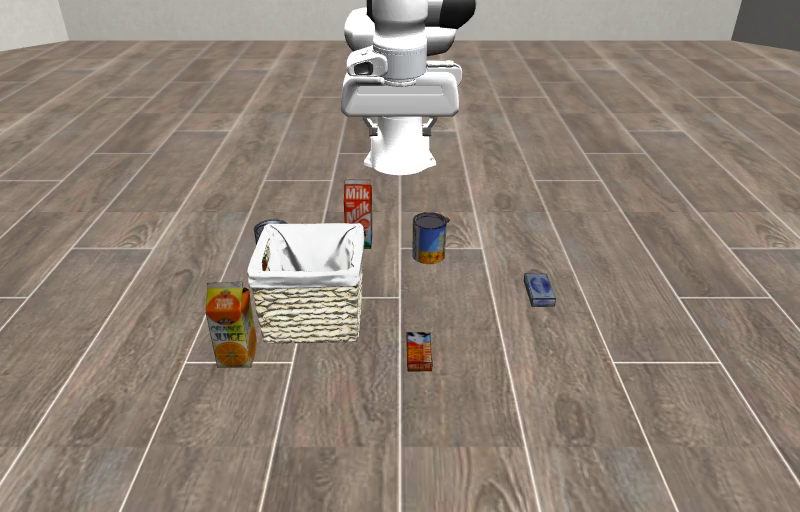
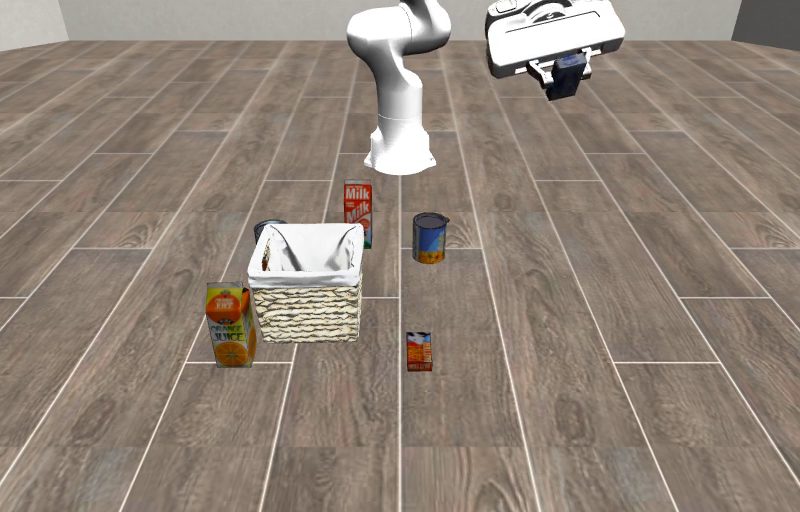
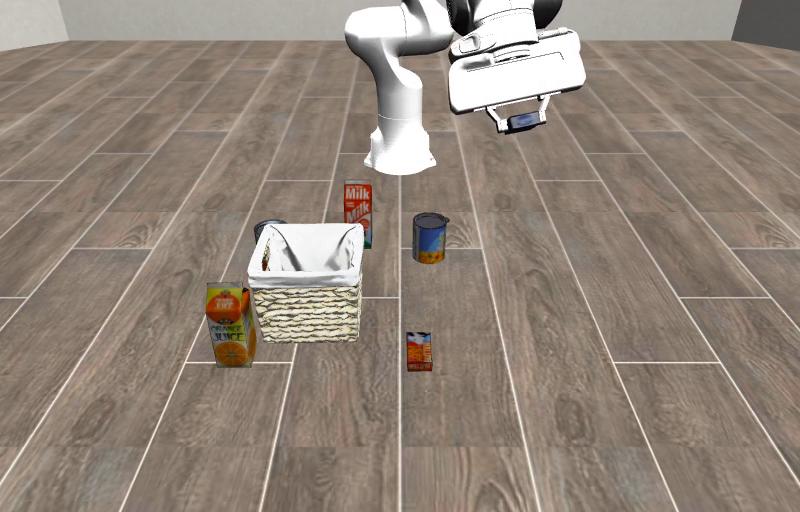
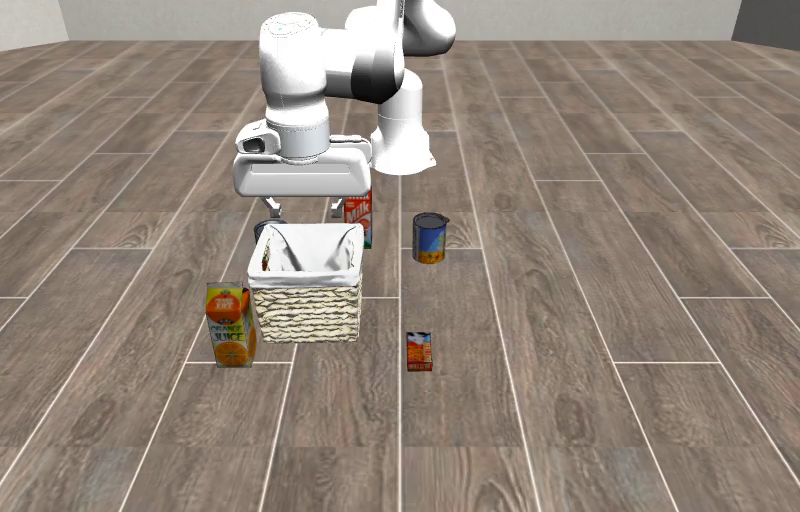
You may also see generated perception-audit checkpoints report
passed=False (e.g. target_obb_matches_truth): those compare the
robot-frame perception OBB against the world-frame privileged pose — a
frame mismatch in the generated predicate, not a task failure. The physical
checkpoints (target_held, target_in_basket) are the ground truth.
Checkpoints run in warn mode by default, so the run continues either way;
see Checkpoints.
4. Watch and debug#
uv run gap viz          # browse trials at localhost:9432 —
                        # graph swimlane, per-node I/O, masks, plans
The trace browser renders the graph swimlane, per-node resolved inputs and
outputs, and the image assets each node produced (camera frames, perception
masks). Watch the recorded run by opening
outputs/agent_gen_sim/run_video.mp4 from disk with any video player, read
the raw execution record in outputs/agent_gen_sim/dag_trace.json, and
diff two runs with gap trace-diff <a> <b>. More in
Traces.
5. Iterate#
Ask the agent to fix or extend the graph (it edits
workflow.json/ scripts and re-validates), or hand-author withgap.builder— see Build a Graph and the Builder guide.Missing a capability?
gap skills new my-skill --kind skillscaffolds a bundle with a unit test;gap skills test my-skillruns it (Authoring bundles, Testing bundles). Your own registries layer over the public one:gap registry init(Registries).Claiming success rates needs
gap benchmark <yaml> --gate(Benchmark), not one green run.
Warning
The skill hard-gates real-robot commands — an agent will not run
gap run --real ... without your explicit confirmation, sim-first. Read
Safety before any hardware work.