LIBERO Quickstart#
Note
Requirements: a GPU, the quickstart extra, and an API key for a hosted
VLM (OpenRouter by default — alternatives below). Each trial
takes ~25–55 s on an A100 once models are warm; the first trial of a session
runs minutes longer while they load cold.
This is GaP’s end-to-end hero example: a static, fully-authored workflow
graph that perceives a target object and a container with real vision models
(Grounding DINO + SAM3 + a hosted VLM), derives a top-down grasp from the
fused 3D oriented bounding box, picks the object with a direct-IK
align-then-descend grasp, and places it in the basket — verified by the
sim’s own success predicate and a ground-truth target_held checkpoint.
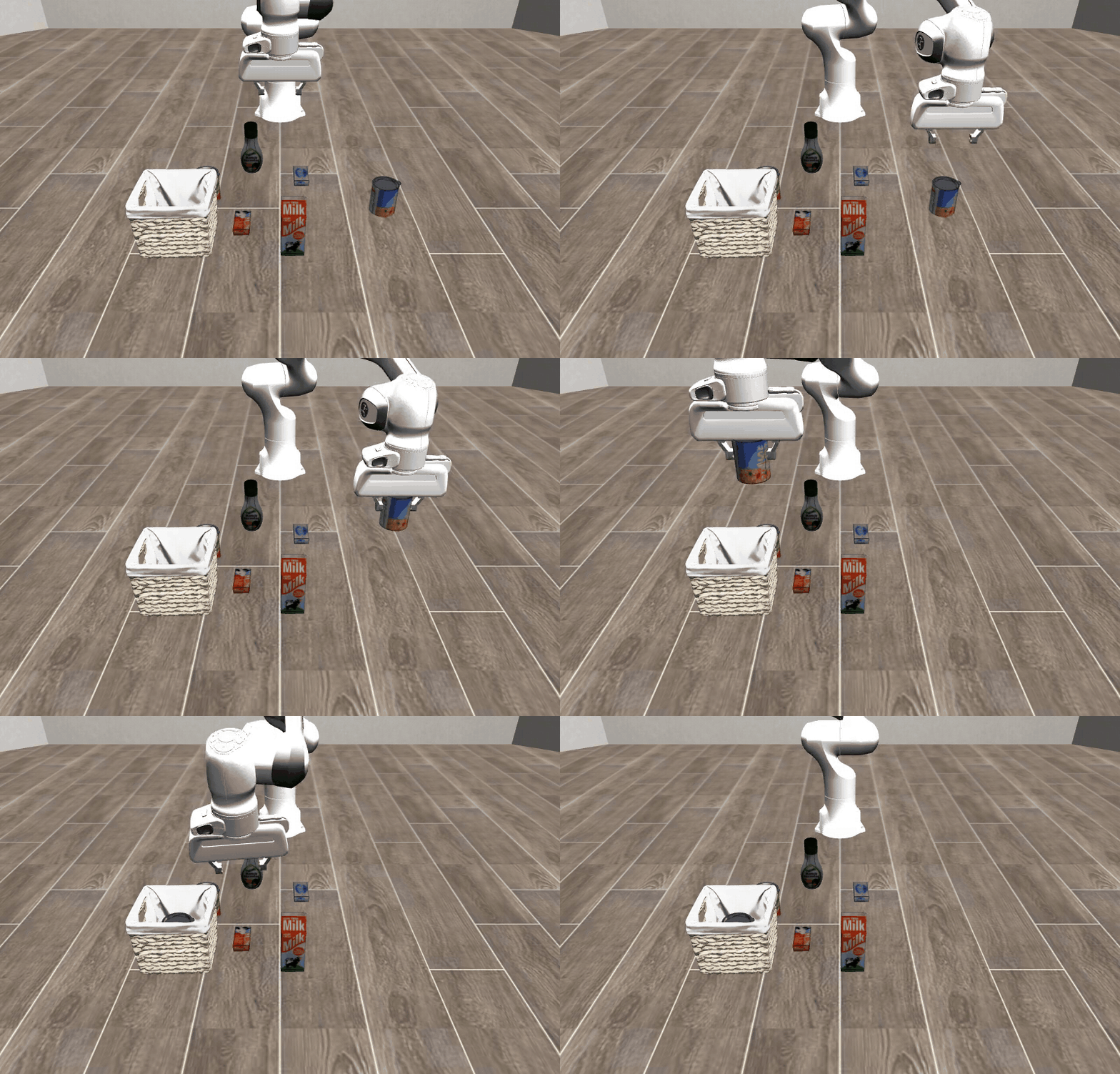
The graph lives at examples/libero_quickstart in the engine repo. Nothing in it is generated at run time: every node, edge, and script is on disk, so you can read exactly what the robot will do before it does it.
Run it#
From the GaP checkout, with open-robot-skills cloned next to it (see Installation):
uv sync --extra quickstart            # engine + LIBERO sim + perception deps
uv run gap skills check --download    # validate every bundle (PASS/WARN/FAIL)
export OPENROUTER_API_KEY=...         # VLM provider — alternatives below

MUJOCO_GL=egl uv run gap run examples/libero_quickstart/graph \
  --sim libero_object_all_variance/0
uv run gap viz                        # browse the recorded trial
A few things to know:
MUJOCO_GL=eglis required on every sim run command (headless rendering).The open-robot-skills checkout is auto-discovered:
$GAP_SKILLS_PATHor the checkout next to the graph-as-policy checkout.--skills PATHoverrides; see Registries.--validate-onlychecks the graph against the skill registry without executing anything.--checkpoints warn(the default) evaluates the ground-truth postcondition checkpoints ingraph/checkpoints/after each subgraph — sim only. Thegrasp_sg.target_heldcheckpoint verifies via privileged contacts that the gripper actually holds the can afterclose, not an empty grip.Traces (per-node inputs and outputs, every model call, rendered frames) land in
outputs/run_<timestamp>/— see Browse the trace.
Model weights (facebook/sam3, IDEA-Research/grounding-dino-base)
download from HuggingFace on the first model call; the --download flag
runs each bundle’s optional prefetch() hook for bundles that define one.
The quickstart extra pulls torch, torchvision, SAM3 (pinned to a git SHA),
Grounding DINO (transformers), and the CPU geometry deps — all pinned by the
committed uv.lock.
Graph anatomy#
START → target → container → grasp → transport → done
            ↘ not_found      ↘ failed   ↘ blocked → abort (open gripper, go home)
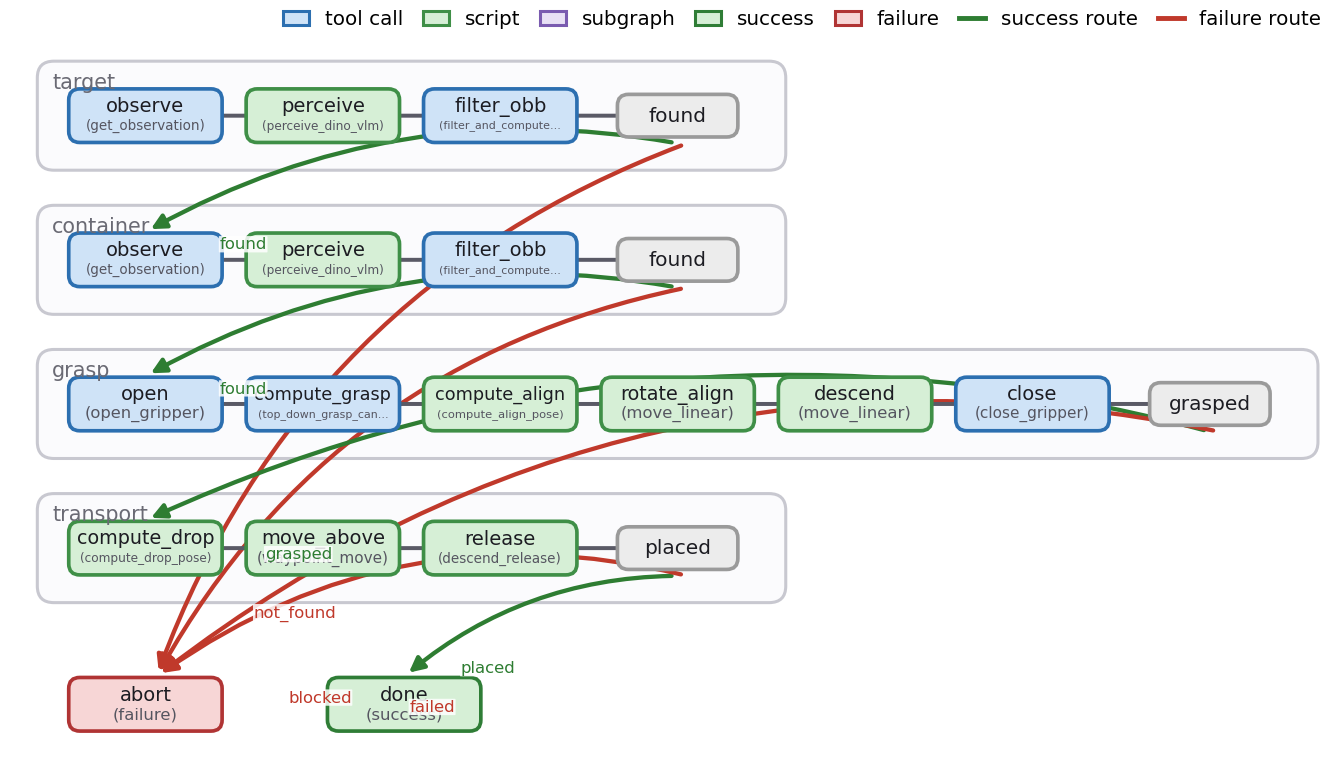
Four subgraphs, each implementing a skill recipe from open-robot-skills:
target_sg (perceiving-objects): a single DINO detect + pairwise-VLM crop tournament + SAM3 perception path on one observation, back-projected to a world-frame cloud, producing the target’s oriented bounding box and mask.
container_sg (same bundle): DINO+VLM perception of the basket, then
geometry.filter_and_compute_obbfits the container OBB.grasp_sg (grasping-direct-ik):
robot.open_gripper→geometry.top_down_grasp_candidates(obb)→ compute the align pose 15 cm above the OBB top →robot.go_to_pose(rotate to the grasp yaw at altitude) →robot.go_to_posestraight down tocandidates.poses[0]→robot.close_gripper.transport_sg (transporting-objects): drop pose from the container OBB → lift to 0.45 m and move laterally with
robot.go_to_posewaypoints → descend, open,robot.go_home.
Dataflow between subgraphs is bound by name: grasp_sg declares an
input target_obb, and the executor binds it to the upstream output of the
same name from target_sg — no explicit wiring. Each subgraph declares an
on_error exit (not_found, failed, blocked), so any raised exception
routes to the abort end node, which runs recovery actions
(robot.open_gripper, then robot.go_home) before exiting with failure.
Scripts under graph*/scripts/ are per-workflow copies of the canonical
bundle scripts in open-robot-skills (skills/<bundle>/scripts/); the
subgraph’s skill: field names the owning bundle so scripts import under
its package. See Workflow schema for the
JSON format and Patterns for the recipes used
here.
Tip
time.sleep() does not advance the LIBERO sim. The graph instead passes
settle_steps to the gripper tools (40 on open, 60 on close) so physics
settles before the next node runs.
Two variants#
Graph |
Grasp strategy |
Needs |
|---|---|---|
|
direct-IK align-then-descend (grasping-direct-ik): pre-rotate to the grasp yaw at a safe height above the OBB, descend straight down, close |
|
|
CuRobo goal-set planning over the same grasp candidates (grasping-with-planner): reconstruct a collision world from RGB-D, plan a collision-free joint trajectory to the best reachable candidate |
|
The two graphs differ only in the grasp subgraph; perception and
transport are identical. In graph_planner/ the grasp becomes: approach
above the target → re-observe → geometry.build_world_config (collision
scene from RGB-D, with the target carved out by its SAM3 mask) →
curobo.plan_to_grasp_poses over the full candidate set →
robot.execute_trajectory. The default graph/ is deliberately
planner-free so the quickstart needs no CuRobo install.
To run the planner variant, install CuRobo first (CUDA build), then point
gap run at it:
CUDA_HOME=/usr/local/cuda uv sync --extra grocery
MUJOCO_GL=egl uv run gap run examples/libero_quickstart/graph_planner \
  --sim libero_object_all_variance/0
VLM provider#
The perception pipeline disambiguates DINO detections with a hosted VLM (the
vlm.query tool). The default provider is OpenRouter:
export OPENROUTER_API_KEY=...                 # default provider; model override:
export GAP_VLM_MODEL=gemini-3.1-pro-preview   # optional (unset = gemini-3.1-flash-lite-preview)
Alternative — Vertex AI with application-default credentials (what the measured results below used):
uv sync --inexact --extra vertex       # the vertex SDK (google-genai)
gcloud auth application-default login
export GAP_VLM_PROVIDER=vertex
export GAP_VLM_PROJECT_ID=<your-project>
export GAP_VLM_REGION=global
export GAP_VLM_MODEL=gemini-3.1-pro-preview
The default openrouter provider is OpenAI-compatible, so pointing at any
other such endpoint (e.g. a local vLLM server) just needs a base-URL override:
export GAP_VLM_BASE_URL=...            # your endpoint (e.g. local vLLM)
export GAP_VLM_MODEL=...               # model served at that endpoint
export GAP_VLM_API_KEY=...             # only if the endpoint requires one
The full variable list is in Environment variables; provider setup for graph generation (a separate LLM call path) is covered in LLM providers.
What can go wrong#
When a trial fails, the trace almost always points at perception, not the grasp mechanics:
Target mis-identification — the DINO + VLM disambiguation picks the wrong detection, so the grasp executes cleanly at a wrong-object location. Shows up as a
target_heldcheckpoint failure.Container perception — a degenerate or oversized basket OBB shifts the drop pose, so a held object is placed next to (or on the rim of) the basket. The planner variant shares the same perception subgraphs, so CuRobo does not recover these.
Wall-clock is ~25–55 s per trial on one A100. Models stay resident across trials within one process, so the first trial pays the cold model loads and can take a few minutes end-to-end.
Seed semantics#
Each seed deterministically selects one of the task’s baked initial object
layouts ((seed - 1) % n_inits over the suite’s 50 baked init states), so
seeds 1–10 cover ten distinct scenes — same convention the
benchmark harness uses for its
n_seeds trials. From Python you can pin a seed via the connector:
conn = gap.connector.sim("libero", task="libero_object_all_variance/0", seed=3)
Warning
A single green run — or ten — is not a success-rate claim. Claims need
gap benchmark <yaml> --gate; see Benchmarking.
Browse the trace#
Every run writes a trace directory (default outputs/run_<timestamp>/;
override with --trace-dir). Inside:
dag_trace.json— the full execution record: node order, routing decisions, timings, checkpoint results.node_data/<subgraph>.<node>/— per-noderesolved_inputs.json,output.json, toolcalls/, andassets/(camera frames, perception masks rendered as PNGs).workflow.jsonandscripts/— a copy of exactly what was executed.
Launch the trace browser:
uv run gap viz # serves http://127.0.0.1:9432
It scans outputs/ recursively for trials and shows the graph swimlane,
per-node inputs/outputs, and image assets (camera frames, masks). Add
--record-video to the run command to also save
<trace-dir>/run_video.mp4, which you watch from disk with any video
player. To compare two runs node-by-node, use gap trace-diff <a> <b>.
More in Traces.
Next steps#
Build a Graph — author this same graph in Python with
gap.builder.Generate a Graph — let the LLM pipeline author it from one instruction.
Agent Quickstart — have Claude Code drive the whole loop for you.
Grocery Fulfillment — the generated-graph acceptance benchmark built on the same skills.
Checkpoints — how ground-truth postcondition verification works.