Overview#
The graph is the policy. GaP compiles a natural-language task into a typed, verified execution graph of robot skills — and runs the graph, not a black-box policy, on simulators and real robots.
import gap

conn = gap.connector.sim("libero", task="libero_object/0")        # one process, no extra terminals
result = gap.execute("examples/libero_quickstart/graph", conn)    # skills auto-discovered
graph = gap.agent.generate_sync("pick up the soup can and put it in the basket")
print(graph)                                                      # the policy, as a graph
gap.viz.serve("outputs")                                          # browse the trial trace
Abstract#
GaP (Graph-as-Policy) targets Variational Automation (VA) — tasks a robot must perform persistently and reliably across many varying instances (objects vary in geometry and pose), not just solve once. Model-free policies struggle to close this reliability gap. GaP is a multi-agent coding harness that turns a natural-language task into a directed computation graph of modular skills (MORSL), self-improves it through simulation rehearsal, and ships it to an edge device for persistent execution — evaluated across 8 Variational Automation benchmarks (4 sim + 4 real); results are on the project page.
Highlights
We identify Variational Automation (VA) — a class of tasks, between fixed automation and full generalist robotics, where a robot persistently performs varying instances of a task with non-trivial variation in object geometry and pose (e.g., sort packages, make coffee, build sandwiches).
Graph-as-Policy (GaP) represents a robot policy as a directed computation graph of modular perception, planning, and control nodes — harnessing the open-world adaptivity of LLM coding agents while preserving an interpretable, reliable structure.
A hierarchical multi-agent harness decomposes a natural-language task, has Skill Agents synthesize localized subgraphs from the Modular Open Robot Skill Library (MORSL, 51 initial skills), and wires them into a type-checked executable graph.
GaP rehearses graphs in an internal Isaac simulation across parallel sampled task instances, uses physical contact and state feedback to localize failures to specific nodes, and iteratively refines graph topology and parameters before deployment.
GaP is evaluated on 8 new open VA benchmarks (4 sim + 4 real) against VLA, TAMP, and single-agent code-as-policy baselines — see the project page for the results.
What is Variational Automation — and why GaP is different#
Many agentic-coding papers solve a task once. GaP targets Variational Automation (VA): a robot must perform varying instances of a task — persistently and reliably — with non-trivial variation in the geometry and pose of objects, inside a known, bounded workcell. VA sits between fixed automation and full generalist robotics:
Fixed Automation (FA) — persistently repeats identical motions (spot welding, spray painting). High reliability, zero adaptivity.
Variational Automation (VA) — persistently performs varying instances (different SKUs, poses, arrangements) within a known workcell. This is GaP’s target.
Generalist Robotics (GR) — open-ended tasks via model-free end-to-end VLA policies. Flexible, but not yet at commercial / industrial reliability.
Why not just single-agent Code-as-Policy?
Single-agent Code-as-Policy (CaP) prompts a coding agent to emit free-form Python. For persistent, repeated execution this is unstructured: the context window grows, constraints are hard to obey, and agents are prone to hallucination and “cheating” on success metrics. GaP’s directed computation graph revives the structure proven in the Robot Operating System (ROS) — routing data through an explicit graph to manage dependencies and ensure reliable execution — and layers the open-world adaptivity of pretrained LLM coding agents on top, preserving an interpretable policy that stays reliable across a VA task’s many instances.
The grocery benchmark family, runnable here#
The two simulation benchmarks from the paper’s grocery family ship in this repo as runnable examples — the same graphs, suites, and configs:
Grocery Fulfillment — pick a described grocery item into the basket under pose / permutation / basket-swap variations; every graph is LLM-generated per task, and the full config is the release gate.
Grocery Packing — pack every item with a loop: a static graph with a real backward edge and unprivileged VLM termination, plus the
gap generaterecipe that reproduces it from one sentence.
Quantitative comparisons against VLA, TAMP, and code-as-policy baselines live on the project page; this documentation stays with what you can run and inspect.
The policy is the graph#
Most robot stacks hide the policy: it is a neural network’s weights, or an
LLM agent’s transient chain of tool calls. In GaP the policy is a durable,
inspectable artifact — a directory containing workflow.json (a version-3
JSON graph), scripts/ (typed Python step bodies), and checkpoints/
(postcondition predicates). You can read it, diff it, validate it, version
it, and execute it deterministically.
Three authoring surfaces produce the identical artifact, all gated by the same strict parser and structural validator:
gap generate— an LLM pipeline (coordinator → per-subgraph agents → checkpoint agent → validate/fix loop) compiles one instruction into a workflow directory. See Generating graphs.gap.builder— a LangGraph-style Python API (Workflow/Subgraph,add_node/add_edge/add_exit/save). See The builder API.Hand-written JSON — anything that passes validation. See the workflow schema reference.
Because the artifact is the contract, execution and verification compose around it: the executor records a full trace of every run, and LLM-authored checkpoints are evaluated against simulator ground truth at every subgraph exit.
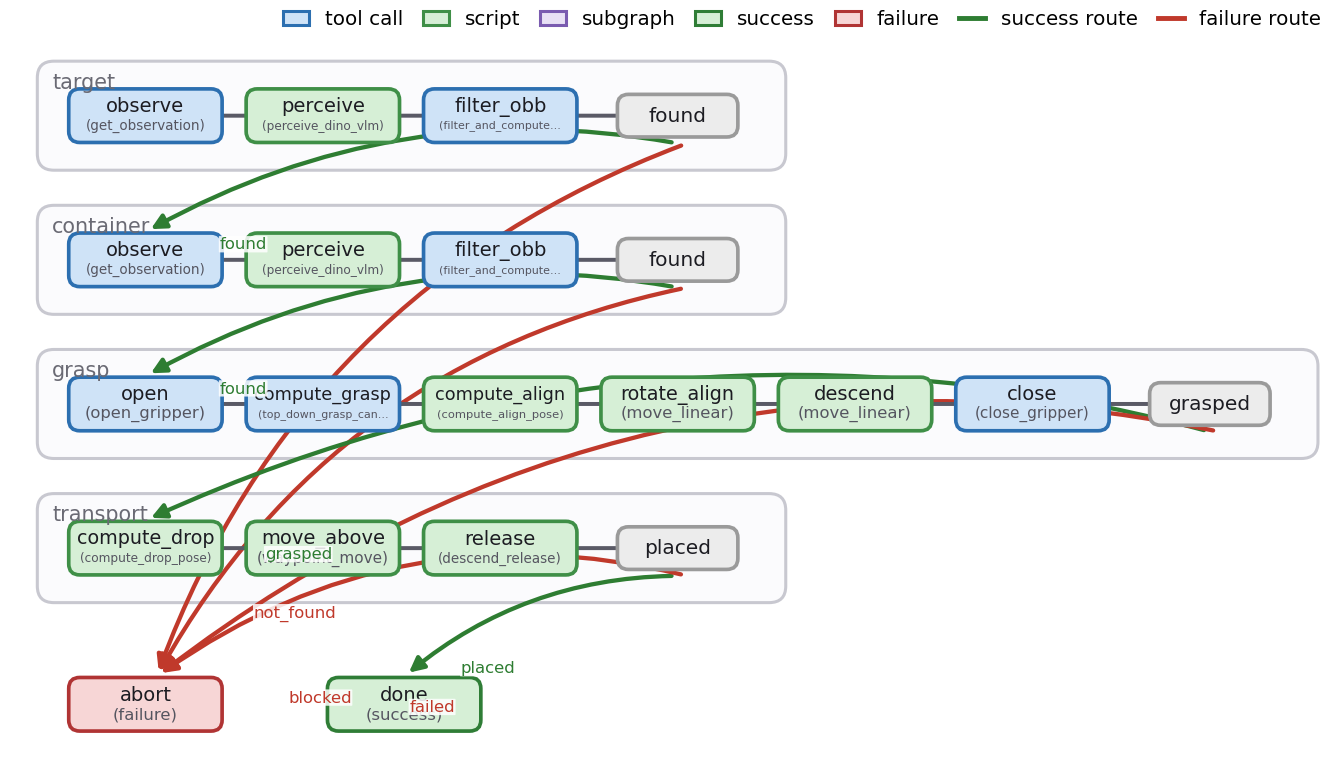
The graph behind the quickstart: perceive → grasp → transport, with exit routing and recovery. Rendered from examples/libero_quickstart.#
Two ways in#
GaP runs the same workflow artifact however you produce it — by hand or from language:
Hand-curated quickstart — the reference graph for
libero_object_all_variance/0. Open a sim, perceive, grasp with in-process IK, transport, verify against ground truth.Generate from language — one sentence to a validated graph. The coordinator → subgraph-agents → checkpoint-agent pipeline picks
perceiving-objects,grasping-with-planner, andtransporting-objectsfrom the skill registry; the result runs end-to-end in sim with LLM-authored postcondition checkpoints enforced at every subgraph exit.Release gate — a grid harness with
--gatefor batch evaluation across modes × families × seeds.
Two repos, discovered by path#
GaP is split into an engine and a skills library:
graph-as-policy (import name
gap) — the engine: runtime, validator, agent pipeline, connectors, environments, benchmark harness, trace viewer.open-robot-skills — the canonical public registry of skill bundles in the Anthropic Agent Skills format: one directory per bundle, contributable with a single PR.
Clone them side by side and every command finds the skills automatically — discovery is by path, never by pip entry points:
your-workspace/
├── graph-as-policy/       # the engine
└── open-robot-skills/     # skill bundles — auto-discovered, no flags
The sibling checkout is only the last layer of a five-level registry
resolution chain (--skills flags, $GAP_SKILLS_PATH, project
pyproject.toml, user config, auto-discovery), so a lab can layer a
private registry that shadows a single public bundle instead of forking
the whole repo. See Skill registries.
Tools vs skills#
The repo layout mirrors a first-class conceptual split:
Tools (
open-robot-skills/tools/<bundle>/) are what the robot can compute: model-backed typed callables with no task strategy. Tool bundles are named after the model —sam3,grounding-dino,gemini-er,molmo,vlm,curobo,geometry— and expose functions likesam3.segment_textorcurobo.plan_to_pose.Skills (
open-robot-skills/skills/<bundle>/) are what the robot can do: manipulation strategies that own subgraphs in generated graphs —perceiving-objects,grasping-with-planner,transporting-objects,tracking-objects, the per-checkpoint learned-policy skillspi05-libero/molmoact-libero, and friends. The LLM composes them; so can you.
A third tool source ships with the engine itself: connector tools
(robot.* / sim.*), the embodiment surface registered by whichever
simulator or real-robot connector you open. The full taxonomy is in
Core concepts and the catalogs in
Skill catalog and
Tool catalog.
Architecture#
┌────────────────────────── gap (engine) ──────────────────────────┐
│ agent/      instruction ─► coordinator ─► subgraph agents        │
│             ─► checkpoint agent ─► validate / fix ─► graph       │
│ runtime/    executor (super-steps, streaming, Send), validator,  │
│             tracing, policy loop, verify/ (World, checkpoints)   │
│ tools/      ToolRegistry: typed schemas, tags→guards, dispatch   │
│ connector/  sim()/real(), env registry, in-process pyroki IK,    │
│             rr_launcher, data collector                          │
│ envs/       libero (+perturbed), franka_real, ur_zed, msgpack    │
│ benchmark/  grid harness (modes × families × seeds), --gate      │
│ viz/        FastAPI+React trial browser, replay3d, PDF render    │
└──────────────┬───────────────────────────────▲───────────────────┘
               │ discovers (by path)           │ registers tools
        ┌──────▼───────────────────────────────┴──────┐
        │ open-robot-skills (Agent Skills format, contributable)
        │ tools/   sam3, grounding-dino, gemini-er,    │
        │          molmo, vlm, curobo, geometry        │
        │ skills/  perceiving-objects(-oneshot/        │
        │          -multiview), perceiving-object-     │
        │          parts, grasping-*, transporting-    │
        │          objects, tracking-objects,          │
        │          pi05-libero, molmoact-libero        │
        └──────────────────────────────────────────────┘
Everything runs in one process: environment, vision models, and IK. No gRPC, no protobufs, no self-hosted model servers — the data contract is plain numpy arrays and TypedDicts. A deeper tour of the packages is in Architecture.
Why GaP#
Language → typed graph. A coordinator → subgraph-agents → checkpoint-agent pipeline compiles one instruction into a validated workflow of skills, with a script-fix loop on validation errors.
Verified, not hoped. LLM-authored postcondition checkpoints are enforced against simulator ground truth at every subgraph exit (
--checkpoints warn|raise).Skills are contributable. Strategies and model tools live in open-robot-skills as Agent Skills bundles — one directory, one PR.
One process, no servers. Env + vision models + IK in-process; Ray is an opt-in extra, never a prerequisite.
The trace is the product. Every run records
workflow.json,dag_trace.json, and per-node I/O and assets;gap vizbrowses them andgap trace-diffcompares them. See Traces.Benchmarked with a gate. A grid harness (modes × families × seeds) with
--gate: the grocery-fulfillment acceptance config must clear its configuredgate_thresholdfor a release. See Benchmarking.
What you need to try GaP#
Requirement |
Details |
|---|---|
GPU |
1× NVIDIA RTX 4090-class GPU (≥ 24 GB VRAM), Linux + EGL. |
LLM |
An API key for a coding LLM — OpenRouter (default, OpenAI-compatible) or Vertex — drives the multi-agent codegen harness. |
VLM |
A vision-language model for perception (object identification & grounding), plus local SAM3 + Grounding DINO weights. A free HuggingFace token is needed for the gated SAM3 weights. |
Tooling |
uv; the first run downloads ~3.5 GB of model weights. |
Scope of v1#
v1 draws the line at language → verified pick-and-place graphs on LIBERO and real Franka/UR. Cut for scope and planned to return after v1: execution-feedback graph repair, learned grasp planners, a remote model-serving tier, bimanual support, Isaac-based rehearsal, non-pick-place domains (articulated, contact-rich, long-horizon), and self-hosted pointing VLMs. Details in the roadmap.
Where to go next#
If you want to… |
Go to |
|---|---|
Install the engine and skills |
|
Run the sim quickstart |
|
Learn the vocabulary (workflow, subgraph, tool, skill, …) |
|
Browse runnable examples, hello-world to real robots |
|
Generate graphs from language |
|
Author graphs in Python |
|
Execute graphs and read traces |
|
Verify runs with checkpoints |
|
Manage registries and write skill bundles |
|
Run benchmark grids and gates |
|
Go to real hardware |
|
Drive GaP from Claude Code |
|
Look something up |