Quickstart: The 15-Minute Tour#
Zero to a verified rollout, with the trace open. You will:
run the checked-in quickstart graph on the LIBERO simulator — vision models, IK, and the sim in one process;
read the recorded trace, the artifact everything else revolves around;
browse it in
gap viz;generate your own graph from one sentence;
loop the same machinery: pack every item on the table, through a graph with a real backward edge.
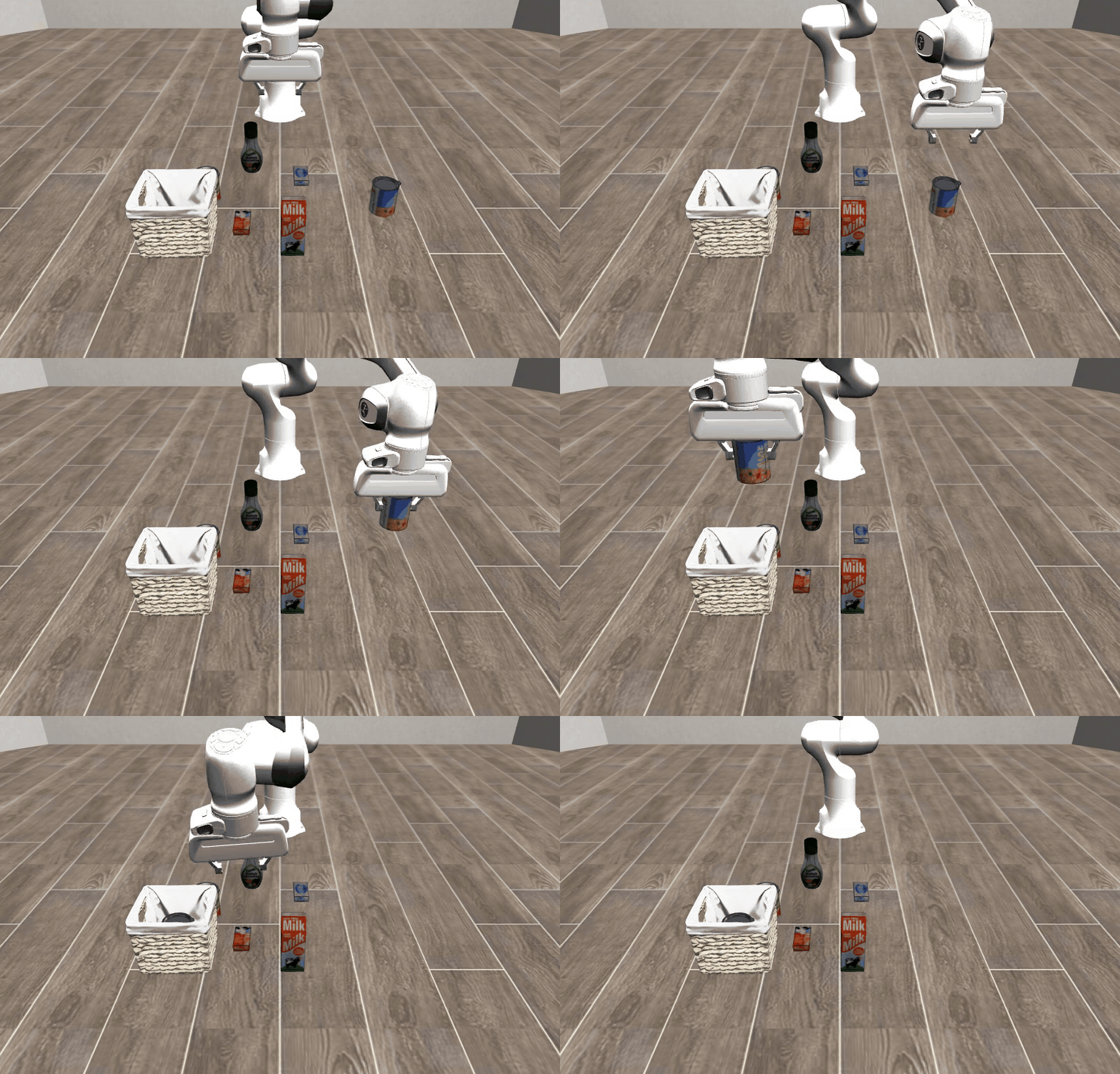
“pick up the soup can and put it in the basket” — live rollout
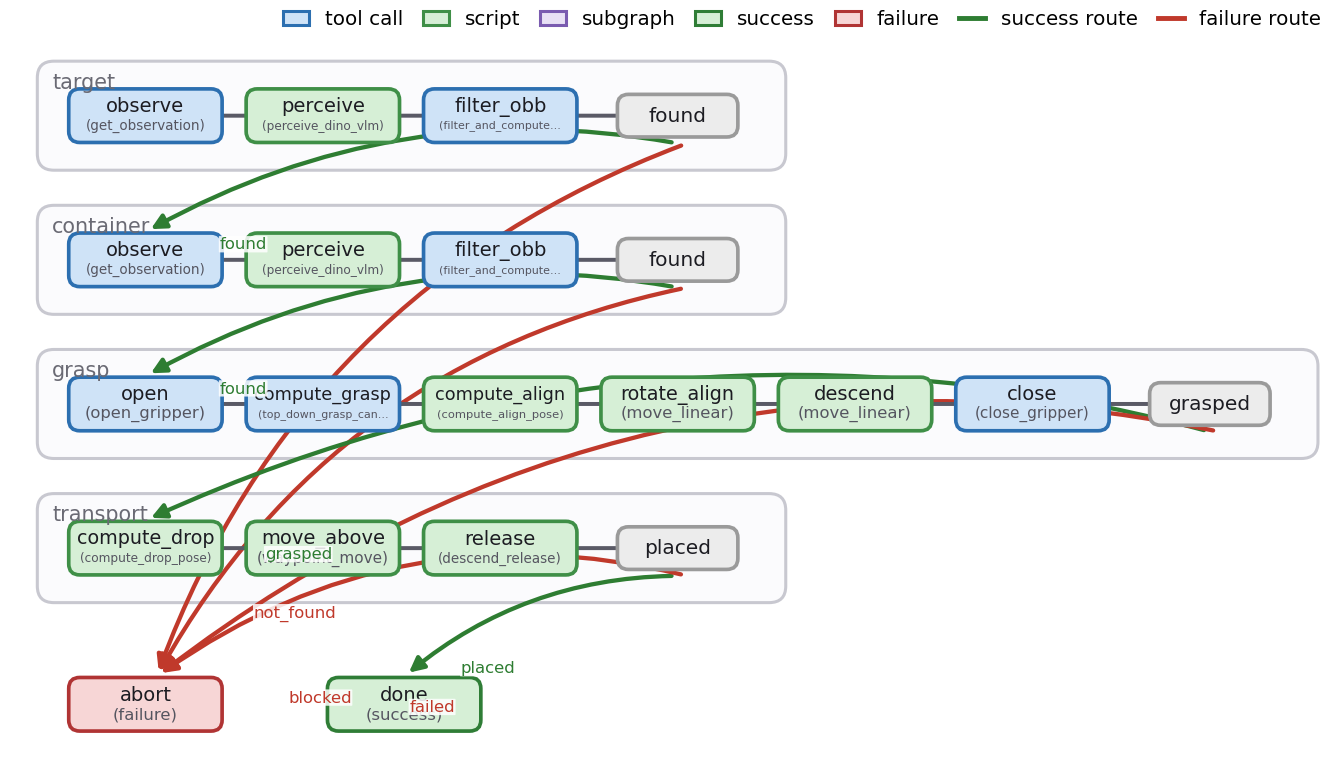
the graph that ran it
Note
Requirements
Linux + an NVIDIA GPU with EGL (~10 GB VRAM covers this quickstart;
Installation recommends ≥24 GB for the full stack), the
two repos installed with
uv sync && uv run gap skills install --all, and an LLM API key
(export OPENROUTER_API_KEY=..., or
another provider). The first run
downloads ~3.5 GB of model weights, and the gated SAM3 weights are in
this quickstart’s perception path — so set HF_TOKEN first; see
Model weights. The closing packing
segment (minute 12–15) additionally needs the CuRobo planning stack:
CUDA_HOME=/usr/local/cuda uv sync --extra grocery.
Minute 0–6: run the quickstart graph#
LIBERO sim + Grounding DINO + SAM3 + a hosted VLM + in-process IK, executing a perceive → grasp → transport graph:
export OPENROUTER_API_KEY=...          # or another provider

MUJOCO_GL=egl uv run gap run examples/libero_quickstart/graph \
  --sim libero_object_all_variance/0
MUJOCO_GL=egl selects headless GPU rendering and is required on every
sim command; --sim SUITE/TASK picks the seeded LIBERO task variation.
While it runs (~25–55 s per trial, measured on an A100 — the first trial of a session runs minutes longer while the vision models load cold; steady-state kicks in from the second trial), what you are watching in the log: perception (Grounding DINO proposes boxes, a hosted VLM picks the right one, SAM3 segments it), geometry (mask + depth → oriented bounding box → top-down grasp candidates), then motion (align, descend, close, transport). That one command, in one process:
launched LIBERO (MuJoCo + EGL) on the seeded task variation;
found the can and the basket with Grounding DINO + SAM3, disambiguated by a hosted VLM;
fused masks + depth into oriented bounding boxes and derived a top-down grasp;
executed perceive → grasp → transport with in-process IK;
verified
target_heldagainst simulator ground truth at the subgraph exit;recorded the full trace to
outputs/.
Two flags worth knowing now: --validate-only checks a graph (structure
plus skill registry) without touching a sim, and
--checkpoints off|warn|raise (default warn) controls how ground-truth
postcondition checkpoints are enforced at subgraph exits — see
Checkpoints.
Reading the trace#
When it finishes, the trace is in outputs/run_<timestamp>/:
outputs/run_<timestamp>/
├── workflow.json        # the graph that ran (self-contained copy)
├── dag_trace.json       # every node visit: timings, exits, errors, routing
├── node_data/<node>/    # per-node inputs/outputs + extracted assets
└── scripts/             # the script nodes, as executed
node_data/ is where debugging lives: the perception node’s directory
holds the camera frames it saw (PNG), the masks and point clouds it
produced (NPZ), and the VLM exchange; the grasp nodes record the poses
they targeted. If a run fails, the failing node’s directory shows exactly
what it was looking at when it failed. The full layout is specified in
Traces — it is a stability guarantee, safe to
build tooling against.
A rollout video is recorded automatically for sim runs: the run is
saved as <trace-dir>/run_video.mp4 alongside the JSON for easy sharing
(plus per-camera videos when the env buffers them). Open it from disk with
any player. Pass --no-video if you want to skip rendering.
Minute 6–8: browse it#
uv run gap viz # browse the recorded trial at localhost:9432
Click into the trial: the graph renders as swimlanes (one per subgraph)
with the executed route highlighted; clicking a node shows its inputs,
outputs, timings, and assets — the same node_data/ you just saw, with
images inline. When two runs disagree,
gap trace-diff <trial_a> <trial_b> diffs them structurally.
Minute 8–12: generate your own#
uv run gap generate "pick up the alphabet soup can and place it in the basket"
The agent pipeline — coordinator → per-subgraph agents → checkpoint
agent — picks skills from the open-robot-skills catalog, writes the
subgraphs and their scripts, attaches ground-truth checkpoints, and
validates the result; on validation errors a script-fix loop repairs its
own output (you’ll see those attempts in the log). The compiled policy
prints in the terminal as a box-drawing graph, and the artifact lands in
outputs/generated_<timestamp>/task_00/ — the same shape as the
quickstart graph’s, so you already know how to read it. Run it:
MUJOCO_GL=egl uv run gap run outputs/generated_<timestamp>/task_00 \
  --sim libero_object_all_variance/0
Note
gap run must target the task_00/ subdirectory, not the --out
directory itself — generation writes one folder per task.
Generation covers the pipeline, providers, and config in depth.
Minute 12–15: loop it — pack every item#
One pick is a straight line through the graph. The packing example runs the same perceive → grasp → transport machinery in a loop: transport routes back to perception, and the graph keeps picking until a VLM confirms every grocery item is in the basket.
libero_object_packing/0), 2×: one perceive → grasp →
transport pass per item, until the VLM completion check reports the
table clear.CUDA_HOME=/usr/local/cuda uv sync --extra grocery # one-time: adds CuRobo planning
MUJOCO_GL=egl uv run gap run examples/grocery_packing/packing_graph \
--sim libero_object_packing/0
Watch the first pass land and the route bend backward:
transport --placed--> perceive_next resolves to an already-completed
node, so the executor resets and re-runs the loop body — re-perceiving
both the next item and the basket every iteration. Termination is
unprivileged: a per-pass VLM completion check, not a simulator
verdict, decides when the table is clear, so the same policy runs
unchanged on a real robot. Seeing the backward edge fire once is the
point of this segment; a full pack takes roughly a minute per item (plus
a one-time ~40 s CuRobo kernel JIT on the first planning call), so let
it finish in the background and open gap viz after — perceive_next
is visited once per object.
Grocery Packing dissects the loop in
depth: the subgraphs, the backward-edge (subgraph-revisit) semantics,
the layered termination signals, and the gap generate recipe that
reproduces this same graph from one sentence.
Where next#
You want to |
Go to |
|---|---|
See everything GaP can do |
|
Understand the vocabulary precisely |
|
Author graphs in Python |
|
Write or contribute a skill |
|
Make a success-rate claim |
Benchmarking — one green run is not a number |
Move a real robot |
Safety first, then Franka pick & place |